
.png)


Providing the optimal soil environment for microbial applications is key
A recent year long grassland trial conducted by AerWorx has shown substantial potential benefits when soil microbial applications are added to soils that have had compaction alleviated.
Background
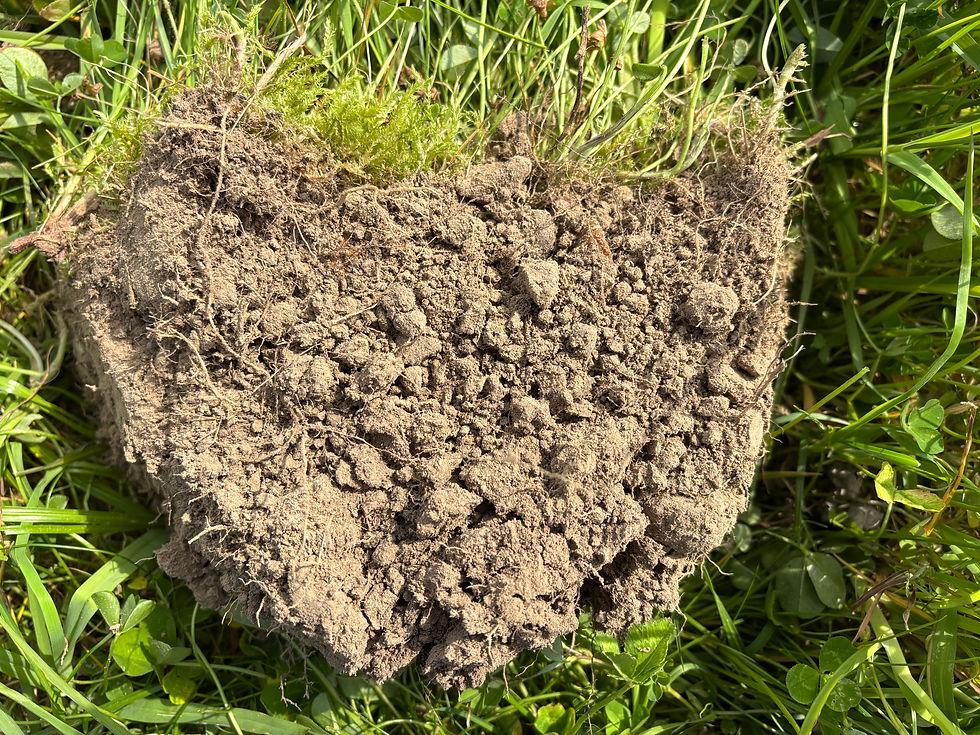
For most microbial populations, air and water cycling within the soil are needed for colonies to survive and thrive. When soils become compacted, the soil's pore spaces are lost leading to inert, anaerobic and often acidic environments. Water and air cannot penetrate the dense blocky structures and microbial survival, plant productivity and health, as well as water management issues, become limiting factors.
It is now common knowledge that the interactions between plant and the soil's natural biology is a vital one. These microscopic microorganisms - bacteria/ fungi/ nematodes etc. will make nutrients available (such as carbon, phosphorous and potassium) as well as converting the atmosphere's nitrogen in to a form usable by roots. They seek water for the plant from parts that the roots can't reach, they provide "PPE" for the roots in the form of a protective film and are instrumental in keeping the soil structure an open sponge. In return, the plant roots supply these microbes with the food that they need in the form of plant sugars.
In recent decades, with the use of heavy machinery, traditional grazing patterns and heavy sudden rainfall events, compaction has gradually become a feature of our UK soils. 4 million hectares of UK's agricultural land are thought to be at risk of compaction ( Environmental Agency 2023) . Soil biology has consequentially declined and we have "bridged this gap" with the application of NPK ( Nitrogen - Phosphorous - Potassium)) i.e. synthetic fertilisers. The "trade agreement" between plant and soil biology then switches off and the soils' natural resource and therefore resilience, declines. The biology disappears and the reliance on synthetics becomes self perpetuating, alongside the issues faced because of a lack of water infiltration.
In recognition of the detrimental effects of the synthetic applicants, both environmental and financial, many are now looking to restore the soil's natural biology - an underground army of microbes ready to optimise production and assist with maintaining a healthy soil structure. If soils have a porous sponge like structure, water can infiltrate easily, rather than sitting on the surface, depriving roots, causing waterlogging, run off and flooding.
Productivity and water management issues are ultimately improved by decompacting soils.
The Trial
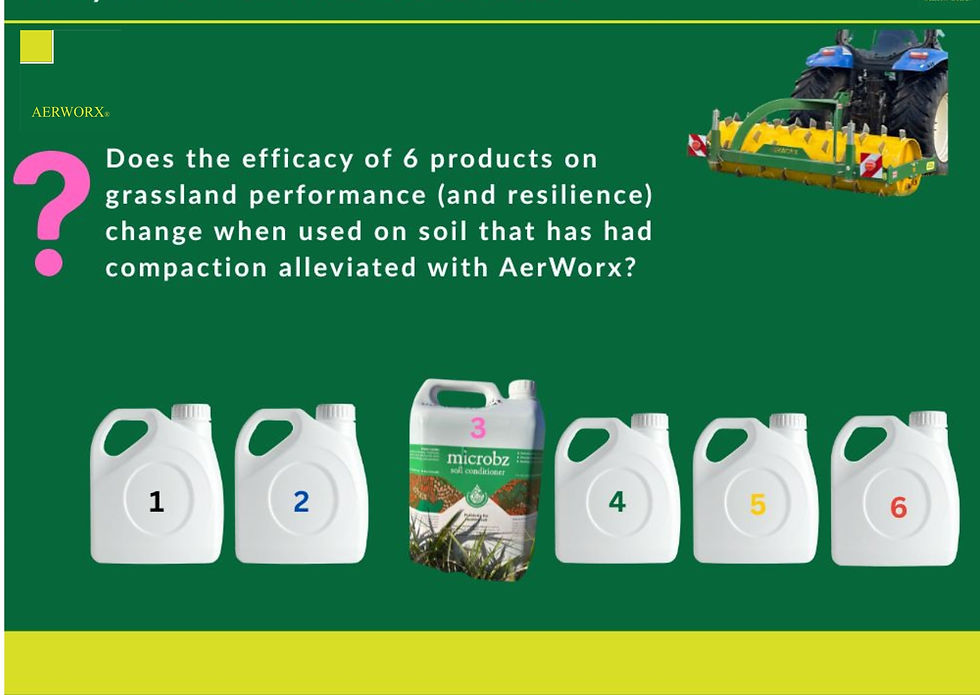
A year long grassland trial, starting in August 2025, looked at whether the efficacy of 6 soil applicants changed when applied to soil that had been decompacted with AerWorx.
Grass productivity (standing dry matter uplift using a platemeter) , water infiltration (soil infiltration tests) and soil biology (soil microscopy) were monitored through the year, including through the prolonged period of drought.
Each product was assessed using:
a) a plot without AerWorx
b) a plot with AerWorx,
and compared to a Control (untreated) and an AerWorx only plot.
Preliminary findings
Dry Matter
Further specific product results will be available when the trial is completed and written up but for Product 3, with permissions from microbz, a pronounced synergy when this product was used with AerWorx, was observed throughout the trial.
PLEASE NOTE - FIGURES REFER TO STANDING GRASS DRY MATTER UPLIFT NOT CUMULATIVE YIELD

The control (untreated) was still recovering from the winter when measurements were taken in April 26, compared to measurements taken in August 25.
Applying microbz AFTER a single AerWorx pass gave even greater gains than using AerWorx or microbz alone.
(If forage is valued at an average of £323/T (dairy), this gross gain of 640Kg/ha could equate to an additional forage value of £207/ha)
The average for ALL Product only plots (x6) saw a gain of 213Kg/ha in dry matter over the control
The average for ALL Product + AerWorx plots ( x6) saw a gain of 385 Kg/ha over the control - 172kg/ha more than when products were used alone.
---------------------------------------------------------------------------------------------------------------------------------------------------

Dry matter loss was measured from June - August 26 during the prolonged drought.
The control lost the most dry matter of all of the plots (-460 Kg/ha)
Using Microbz + AerWorx together preserved more grass through the drought compared with when using Microbz or AerWorx alone - only 6.5% of the Control plot loss was lost
The average loss for ALL Products only plots (x6) was -192kg/ha 42% of the control plot's loss
The average loss for ALL Products + AerWorx (x6) was -120kg.ha only. 74% less than the control , suggesting a potential for greater drought resilience when used together.
---------------------------------------------------------------------------------------------------------------------------------------------------
FULL TRIAL YEAR DRY MATTER PERFORMANCE
microbz alone showed a 15% gain in standing grass dry matter compared to the control ( +261kg/ha)
microbz + AerWorx, this gain increased to 26% compared to the control (+456Kg/ha)
(If forage is valued at an average of £323/T (dairy), this gross gain of 456Kg/ha could equate to an additional forage value of £147/ha) over the control.
-------------------------------------------------------------------------------------------------------------------------------------------------
INFILTRATION RATES
The infiltration of water in to our soils is becoming increasingly important as a means of mitigating the impact of extreme weather patterns as we swing from drought to deluge. It is vital that our soils act like a sponge capturing rain in the wetter months, so that the ground can act as a reserve for the drier months.
This is important for not only plant productivity, whether grass or arable, but for water management. Flood management, leaching in to our waterways, field waterlogging, loss of soil and applicants through the run off - all issues that are headlines in the UK. Given that it takes over 500 years to produce 1" of topsoil, it is not difficult to appreciate how important it is to prevent erosive losses of this effectively non renewable resource!
AerWorx, through its "Slot & Shatter" (TM) technique, alleviates compaction to create a porous open soil.
During this trial, we assessed at various data points, how infiltration rates changed throught the year across all of the plots. Below demonstrates how infiltration rates at the end of the trial year compared with those at the start, pre AerWorx.

Soil was decompacted with AerWorx in AUGUST 25 AND APRIL 26 - a single pass on each occasion
AerWorx improved infitration rates for 100% of the products
AerWorx + product treated plots showed an average 90% faster infiltration rate at the end of the trial year.
Products only plots showed an average of only 27% faster infiltration.
CONCLUSION
“Building resilient soils requires both physical structure and biological function. The preliminary findings from this trial suggest that applying soil applicants such as microbz, can improve grassland yield and drought resilience compared with the untreated control, but when applied to soils where compaction had first been alleviated using AerWorx, even greater gains are made”
This trial has now been extended to monitor how the grass plots recover after the extended period of drought in Summer 26. A full detailed report will be written up in due course where further product details and results will be available.
With thanks to:

All rights reserved. No part of this material may be reproduced, copied, distributed, published or used in any form without the prior written permission of AerWorx Limited.